

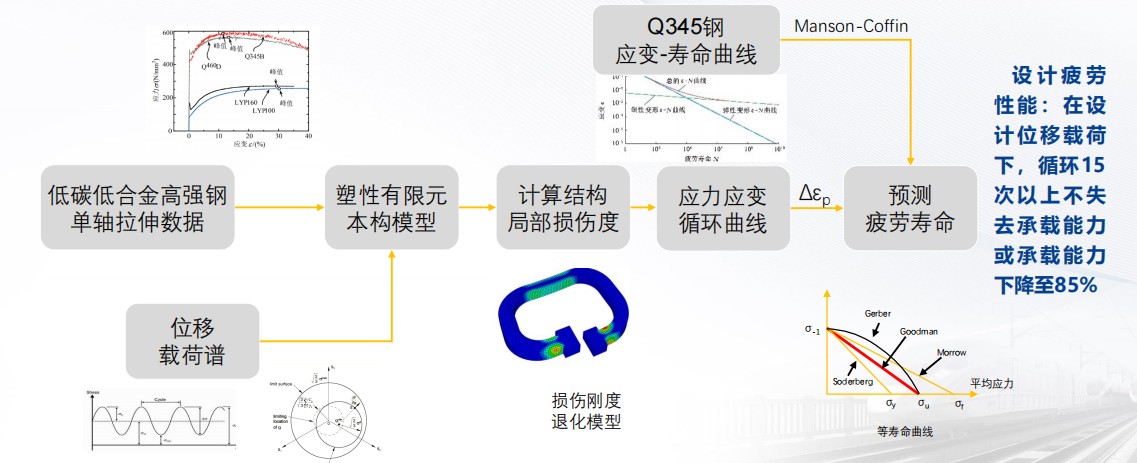
Analysis of plastic damage and LC fatigue life of high-strength steel
§ Based on the metal plasticity constitutive theory, a high-strength steel cyclic hardening model is established using fatigue experimental results.
§ Write finite element method user subroutines to calculate the plastic accumulation and damage of the structure
§ Use low-cycle fatigue life theory to predict the fatigue life of steel structures
Theoretical model and finite element calculation of dynamic crack propagation
§ Based on Griffith fracture theory, a finite element model of dynamic crack propagation including mechanical and electrical coupling was established.
§ The finite element model accurately predicts the dynamic expansion path of type I and II cracks.
§ Finite element model can analyze crack growth forms under complex forces and electrical loads.

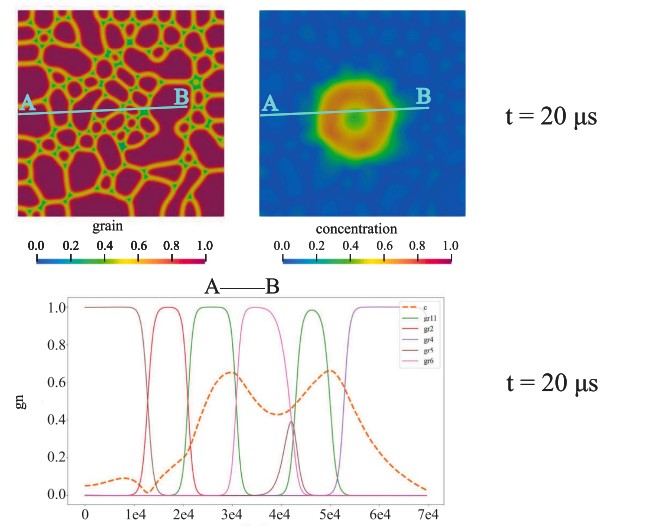
Simulation of grain evolution of aerospace high-temperature metal carbide structural composites
§ Establish grain evolution phase field model and finite element code for high-temperature load-bearing components and materials
§ Study the quantitative relationship between grain fineness, grain boundary width, external force and concentration at different temperatures
§ Establish the metal carbide concentration diffusion theory and analyze the influence of carbon concentration gradient and interface effect on carbide diffusion rate
§ Use the diffusion rate exponential relationship to establish a temperature-carbon concentration-grain orientation multi-field coupling model to improve process parameters